Termination of Employment – Retirement Pension, Severance Payment, Termination
- Retirement Pension – There are 2 types of retirement pensions:
- Defined Benefit (DB) Plan: Retirement pension system in which the severance pay is set in advance based on the salary of 3 months immediately before retirement.
- Defined Contribution (DC) Plan: If the company accumulates 1/12 or more of the total salary of workers every year, it is a system in which workers can directly manage this amount and make a profit.
- Termination Process –
- The company shall pay employee all amounts, including last salary and severance pay, within 14 days after the last working day.
- The deadline for reporting the termination of the four major insurance is as follows.
- Health Insurance – Within 14 days after the final working day.
- National Pension, Employment Insurance, Worker’s Compensation Insurance – Within 15th of next month after final working day.
- Due to process of dismissal (Article 27, 26, 23 of the Labor Standards Act):
- The reason for the employee’s dismissal should be specified in detail. (For the responsible reasons of the worker, the company must fire for justifiable reasons.)
- 30 days prior notice of dismissal.
- Specific reasons for dismissal and timing of dismissal shall be notified.
- Notice of dismissal must be made in writing.
- Pay in lieu of notice –
- In accordance with Article 26 of the Labour Standards Act, the standard for payment of dismissal notice allowance is ordinary wages.
- Ordinary wages include fixed payments such as meal, vehicle maintenance expenses.
- If the company is notified before 30 days, there is no need to pay dismissal allowance.
- If the company is notified less than 30 days, there is a need to pay 30 days of monthly ordinary wage.
- Ordinary wages include fixed payments such as meal, vehicle maintenance expenses.
- Standard guidelines that dictate the termination notice should:
- Be in writing,
- Include the reasons for termination,
- Include the date of termination.
- In accordance with Article 26 of the Labour Standards Act, the standard for payment of dismissal notice allowance is ordinary wages.
- Pay in lieu of notice –
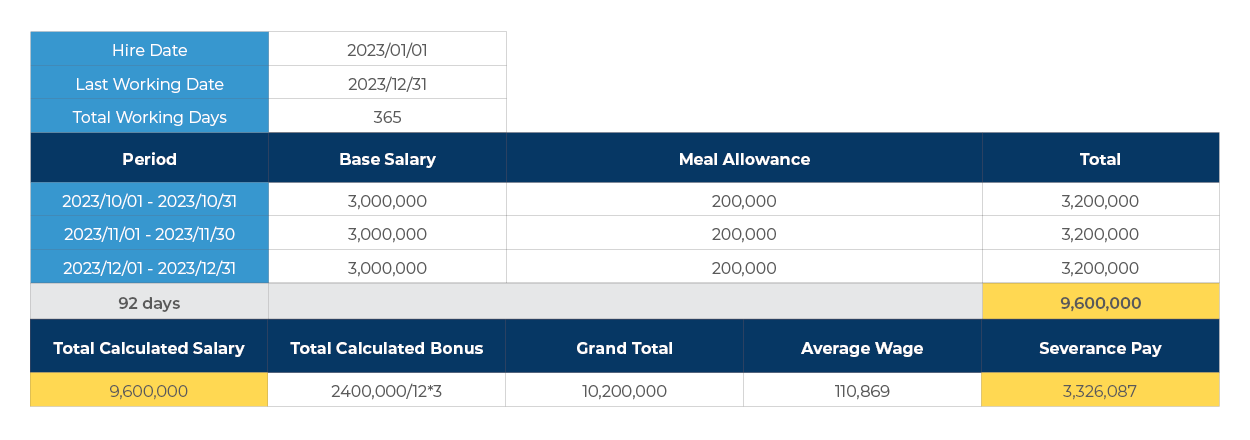
For example: Severance pay
- Employee Join Date: 1 January 2023
- Last Working Date: 31 December 2023
- Basic Salary: 3,000,000 KRW, Annual Bonus: 2,400,000 KRW
Retirement Age
Article 19 of the Act on the Prohibition of Age Discrimination in Employment and the Promotion of Employment for the Elderly has an obligation to comply with the statutory retirement age requirement that “the employer shall set the retirement age of workers at least 60 years old.”
After retirement, the law does not stipulate whether it is possible to rehire regular workers in the form of indefinite or professional contracts according to the company’s needs, so each company can set and implement standards.
Streamline Your Workforce and Focus on Growth
Don’t waste precious time. Get in touch with one of our outplacement experts today and learn how we can get your workforce back on track.
Understanding the legal requirements for terminating employment in South Korea is crucial for maintaining a compliant and fair workplace. By following the guidelines on notice periods, severance pay, and unfair dismissal laws, employers can effectively navigate the termination process while minimising legal risks.
Want to stay up to date with the latest labour laws?
Our publications give you a clear overview of key labour law regulations. We cover major tax, labour law, payroll and visa information. It is designed to get you updated at-a-glance!
Please note that all the information listed below are to be used as a general guideline. For more detailed accounts of South Korea employment laws and regulations, please visit the official governmental websites.
Updated on: 16th January 2025
Contact Us
Get in touch with one of us today to start streamlining your HR processes across Asia & the Middle East.
