One major change on the horizon is mandatory e-invoicing, expected to roll out from 2026. This transition will affect how invoice data is created, exchanged, validated, and stored, making early preparation important for reducing disruption and staying compliant.
For employers, mandatory e-invoicing is not just a finance update, it impacts internal controls, systems, vendor onboarding, tax governance, and how your organisation manages billing accuracy at scale. Getting ready early reduces operational disruption, especially for businesses with high transaction volumes or multiple entities.
What e-invoicing means (and what it is not)
E-invoicing is not emailing a PDF invoice.
The UAE Ministry of Finance defines an eInvoice as a structured invoice dataset that is issued, exchanged, and reported electronically — and specifically notes that unstructured formats like PDFs, Word documents, images, scans, and emails are not eInvoices.
In practice, this means:
- Your invoice data must meet a structured standard (e.g., UAE’s specification, such as PINT AE in programme materials).
- Validations will become tighter (required fields, formatting rules, and error handling).
- Invoice archiving will need to support compliant retention in the required format (not just PDFs).
Key timeline to track
The programme has been rolling forward in stages:
- 24 October 2024: The Ministry of Finance launched the UAE e-invoicing portal and shared programme guidance and FAQs.
- 6 February 2025: A public consultation paper was issued outlining the proposed framework and approach.
- 2026–2027: The UAE is expected to implement e-invoicing in phases, beginning with pilot/voluntary activity before broader mandatory go-live dates (often referenced by advisory summaries as starting from July 2026 for initial onboarding/testing and expanding into 2027 for mandatory compliance by scope).
Because the UAE is taking a phased approach, the most practical employer plan is to prepare for onboarding, testing, and operational readiness well before the first enforcement wave that applies to your organisation.
Who is likely to be impacted
E-invoicing programmes typically expand in scope over time. In the UAE, public materials and advisory summaries indicate a focus on B2B and B2G activity first, with phased onboarding and mandatory requirements by business category/size.
That means:
- Large businesses may be brought into scope earlier.
- SMEs should plan for later waves (but should not wait until the final deadline to assess systems).
- Any organisation issuing invoices to businesses or government entities should assume the change will affect day-to-day billing operations.
How the UAE model may work: accredited providers and structured data exchange
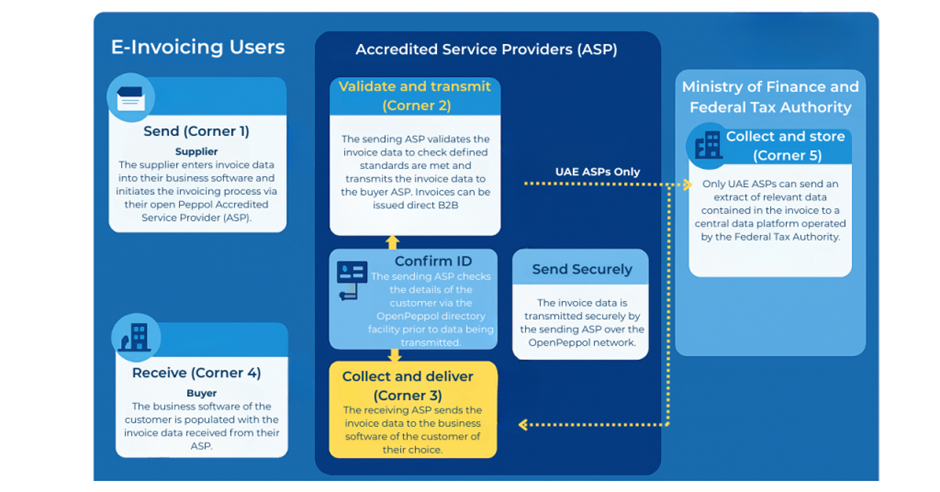
The UAE programme describes a model where invoice data is routed through Accredited Service Providers (ASPs), validated, exchanged between supplier and buyer channels, and reported as required. The consultation materials also reference a UAE standard XML and programme artefacts like PINT AE.
For employers, the biggest operational implication is that system compatibility and data accuracy will matter more than ever — because failed validations can delay invoice delivery, disrupt cash collection, and increase manual rework.
What employers should do now (step-by-step)
1) Map your invoicing processes end-to-end
Document how invoices are created today across:
- entities/business units,
- customer types (B2B/B2G),
- billing triggers (contracts, milestones, subscriptions),
- credit notes/debit notes and adjustments.
This helps you spot gaps early — especially if different teams use different tools.
2) Assess whether your systems can support structured invoices
Review your current stack:
- ERP/accounting platform
- billing tools
- POS systems (if relevant)
- invoicing templates and data master files
If your process relies heavily on manual invoice creation and PDF sending, you will likely need a structured upgrade path.
3) Plan for ASP onboarding and integration
Monitor official updates on pre-approved or accredited providers and prepare evaluation criteria such as:
- integration options (API, file exchange, connectors),
- support for UAE specifications and validation rules,
- implementation support and testing approach,
- service coverage across entities and locations.
4) Strengthen your invoice data quality
Common readiness issues include:
- inconsistent customer master data,
- missing tax identifiers or address fields,
- unclear VAT treatment rules across products/services,
- inconsistent credit note practices.
This is the work that prevents failed validations later.
5) Update policies for archiving and audit readiness
Ensure you can retain invoices in the required compliant format, along with supporting documentation for audit trails. As requirements move towards structured data exchange, retaining only PDFs may no longer meet expectations.
6) Train finance and operations teams on exception handling
Under mandatory e-invoicing, real disruption often comes from:
- rejected invoices,
- missing required fields,
- mismatched buyer/supplier details,
- credit note errors.
Training should cover new workflows for fixing errors quickly, without creating billing delays.
A practical readiness checklist for 2026
Use this as an internal tracker:
- Identify impacted transaction types (B2B/B2G invoicing volume and channels)
- Confirm current invoicing systems and data sources
- Assign owners (Finance + IT + Tax/Compliance + Operations)
- Create an ASP shortlist and integration plan
- Clean master data and standardise invoice rules
- Set archiving and audit documentation requirements
- Pilot test invoice flows before your phase is enforced
The UAE’s programme direction is clear: invoicing is becoming structured, standardised, and increasingly data-driven. Employers that treat this as a cross-functional readiness project, not a quick finance-only change — will be better positioned to avoid billing disruption and compliance risk as rollout phases progress.
Looking for the latest labour law updates and business news across the UAE, APAC, and the Middle East? Subscribe to our blog and for regular insights. With over 25 years of experience in advisory, compliance, and HR outsourcing, Links International is here to support you, get in touch to learn more.