Businesses often opt for EOR services to address a variety of strategic and operational needs. These services provide a flexible and cost-effective way to access specialised skills and expertise, allowing organisations to quickly adapt to changing market conditions, manage workload fluctuations, and fill skill gaps.
The global Employer of Record market is valued at approximately US$5.6 billion in 2025 and is projected to reach over US$10 billion by 2035, growing at a steady CAGR of 6.8%, according to Business Research Insights. This growth is attributed to straightforward expansion opportunities for businesses into global markets, assured local adherence, and compliance with labour law regulations.
Below, we answer all your frequently asked questions on EOR services.
What does Employer of Record (EOR) services refer to?
Imagine a scenario where your business could streamline its hiring procedures by entrusting administrative tasks like payroll, tax, compliance, onboarding and offboarding processes to a third party, enabling your company to concentrate on talent attraction and acquisition. This is precisely what the EOR services model has got to give.
In short, an EOR services provider lets companies outsource their employment-related responsibilities for their staff, compliantly, across the geographical locations where the service provider operates, especially in scenarios where the company do not have a legal entity established at point of employment of staff(s)In this approach, the company’s employees are formally hired by the EOR services provider, which takes on the role of the legal employer and supports the end-to-end payroll outsourcing scope of work including compliance, and personal income statutory obligations.
This arrangement empowers the client to focus on talent retention, including overseeing their staffs’ day-to-day tasks, and prioritise business activities and companies’ initiatives.
Traditionally, companies would go through a very tedious process of setting up an entity, opening a bank account, meeting in-country capital requirements and sourcing for office spaces during international expansion, amongst others. However, with EOR services, companies can hit the ground running with staffs hired by EOR services provider, skipping the lengthy and often intricate aforementioned processes. Consequentially, companies have a head start in testing the market, conducting business feasibility studies before deciding if the market is a good fit for them to expand into. If it is a good fit, they can allocate the right resources, time and material to establish their entity and thereafter transfer these staffs to their own payroll.
How much does EOR services typically cost?
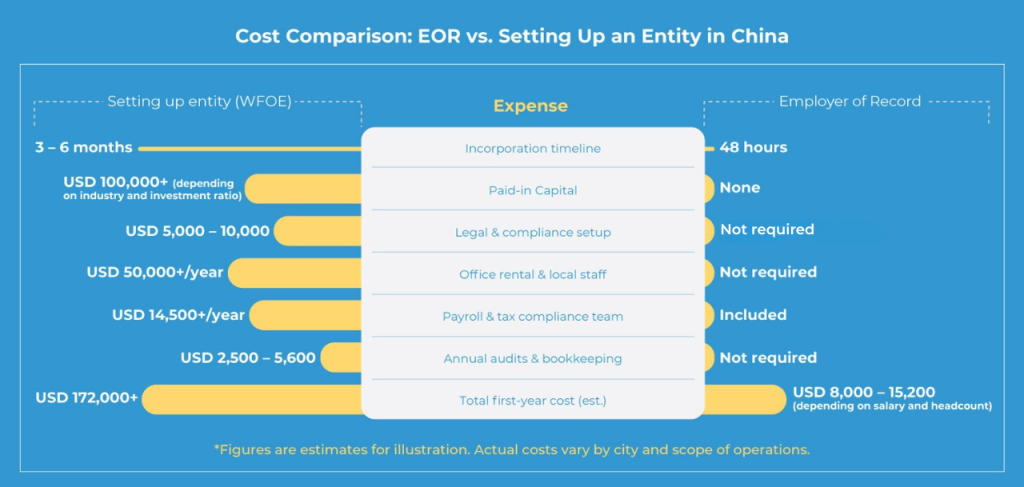
EOR pricing generally takes the form of a monthly fee per employee, which covers the full scope of legal employment, payroll processing, statutory compliance, and HR administration on your behalf.
Rather than focusing solely on the headline fee, it helps to consider what you would otherwise spend. Establishing a legal entity in a new market, covering incorporation, legal counsel, tax registration, capital requirements, and ongoing compliance filings, can run into tens of thousands of dollars per country, often before a single employee is hired. EOR replaces that upfront investment with a predictable operational cost, making it particularly cost-effective for companies testing a new market or managing a small headcount in a given country.
Costs can vary depending on the country of employment, the complexity of the role, the benefits package required, and the scope of services included. When comparing providers, it is worth asking for a full breakdown of fees upfront, including any statutory employer contributions, foreign exchange markups, or additional charges for services such as visa support or offboarding.
How does an EOR handle employee data security and privacy?
When you engage an EOR provider, you are entrusting them with sensitive employee information, including personal identification details, payroll data, tax records, and employment documentation. It is therefore essential to understand how your chosen provider manages and protects that data.
Across Asia, data privacy obligations have grown considerably more stringent in recent years. China’s Personal Information Protection Law (PIPL) is now actively enforced, meaning employee data collected in China must be handled with strict controls around cross-border transfers, storage, and consent. India’s Digital Personal Data Protection Act (DPDPA) is similarly rolling out through 2025–2026, introducing new obligations around lawful basis for processing, data retention, and breach notification timelines. Your EOR provider must be equipped to comply with these requirements on your behalf.
When evaluating providers, key questions to ask include:
- Does the provider hold internationally recognised security certifications, such as ISO 27001?
- How do they manage cross-border data transfers in markets such as China?
- What are their breach notification procedures?
- Are their data processing practices documented in a Data Processing Agreement (DPA)?
How do you know if you’d require EOR services?
These are the key reasons why companies will consider EOR services, and if you find these reasons relatable in any situation you’re in, EOR services might just be the solution for you:

How do I know if working with an EOR provider is more suitable or less suitable than engaging the services of an independent contractor?
Below, we give you a comparison between both:

Have some doubts to be cleared? Speak to our team of 200+ experts today!
In what ways does multi-country EOR vary from multi-country payroll outsourcing?
Multi-country payroll outsourcing involves the management and execution of payroll related activities including the statutory, tax and pension administration for employees situated in different countries, typically when a company has set up local entities. Essentially, the company directly employs its workforce under its own entity, while entrusting the payroll related administrative tasks to an external professional firm.
On the other hand, in the context of multi-country EOR arrangements, employees are legally hired through a professional EOR service provider, who is also in charge of management and execution of payroll related activities including the statutory, tax and pension administration for these employees. The EOR service provider will be responsible for the adherence of all the legalities of employment according to the countries’ labour law, including the preparation of employment contracts, discussing terms of employment, providing labour law advisory, and issuance of group insurance plans.
Try Out Links’ EOR Cost Calculator Now and Get an Estimate Cost on the Employee You Want to Hire!
If you select the EOR services, does the EOR service provider hold the responsibility for supervising employee management?
In short, yes and no. A EOR service provider takes on the role of the legal employer which involves a certain level of communication with the staffs, however, the company is responsible for the day-to-day tasks and as part of it, monitor the performance, progress and deliverables of the staffs as agree during the talent attraction stage. The EOR service provider in turn, takes care of the employment aspects which includes:
- Drafting employment contracts and discussing employment terms,
- Managing payroll, HR functions, and ensuring compliance with labour laws,
- Processing and disbursing salaries,
- Handling statutory and tax processing and submissions,
- Offering group company insurance, where relevant,
- Issuing letters, statutory documents, and payslips,
- Providing in-country support for payroll, HR, and labour law queries,
- Offering a self-service portal for pre-approved vacation and paid time-off (if required),
- Providing visa and immigration support when necessary.
And the company is responsible for:
- Workplace safety and compliance,
- Workplace arrangements and reporting structures,
- Day-to-day performance monitoring,
- Confirming vacation and paid time-off requests (if applicable).
How is the situation handled if an employee must be terminated due to performance concerns?
The EOR service provider and the company is recommended to uphold transparent communication at all times during the lifecycle of the staffs. In the event of performance concerns that might ultimately lead to termination, it is expected that the company informs the EOR service provider about their intention before directly addressing the matter with the staffs. The EOR service provider will offer guidance taking into consideration the local labour law, compliance and industry standards, prior to assisting with all administrative tasks during the termination process in accordance with the labour laws in the respective countries.
Read also: PEO vs. EOR: HR Leaders Should Know the Difference
A checklist of items before deciding on which EOR service provider to work with:
- Understand your options – Whether you are expanding into a new market, managing a hiring freeze, or building a remote team, clarify your specific employment needs before approaching providers. Knowing your objectives will help you assess which EOR model is the right fit.
- Confirm entity ownership – Ask whether the provider owns its own legal entities in your target locations, or whether it relies on third-party partners. Owned entities generally offer greater compliance control, faster service, and clearer accountability.
- Check country coverage and local expertise – Ensure the provider has established operations and in-country HR and legal expertise in the specific markets where you need to hire. Familiarity with local labour laws, tax regimes, and statutory benefits is essential.
- Assess onboarding speed – How quickly can the provider onboard a new employee? In competitive hiring situations, speed matters. Ask for a realistic timeline from contract signing to first day of employment.
- Evaluate benefits quality – In many Asian markets, benefits expectations go beyond the statutory minimum. Understand what the provider offers in terms of group insurance, leave entitlements, and supplementary benefits, as this will affect your ability to attract and retain talent.
- Verify data security credentials – Confirm that the provider holds recognised certifications such as SOC 2 or ISO 27001, and that they have clear processes for managing employee data in compliance with applicable privacy laws in your target markets.
- Scrutinise pricing transparency – Request a full breakdown of all fees, including statutory employer contributions, foreign exchange handling, and any charges for additional services such as visa support or offboarding. Avoid providers who are vague about their fee structure.
- Always stay compliant – When entering an EOR arrangement, ensure the employment terms, contracts, and statutory obligations are managed in full accordance with local law. A reputable provider will guide you through all of this.
- Find the right long-term partner – EOR is not just a transactional service. Choose a provider with a proven track record, strong client references, and the capacity to scale with you as your workforce grows.
Have more questions on EOR services?
At Links, we provide professional employer of record services as a way to help businesses bypass the restrictions imposed by hiring freezes, headcount caps, and overseas employments. Get in touch with one of our representatives to see how we can help you build your business.
Related Articles:
- Top 5 Benefits of Expanding Your Business with PEO/EOR
- Japan Tax: Complete Guide on Year-End Tax Adjustment for Employers and HR Professionals
- In-House vs. Payroll Outsourcing: Which One is Best for Your Business?
- HCM Payroll Integration Guide
Links International is an industry leader in innovative HR outsourcing with services such as payroll outsourcing, visa application, Employer of Record (EOR), recruitment and more! Contact us for more information on how we can help leverage your HR function.